

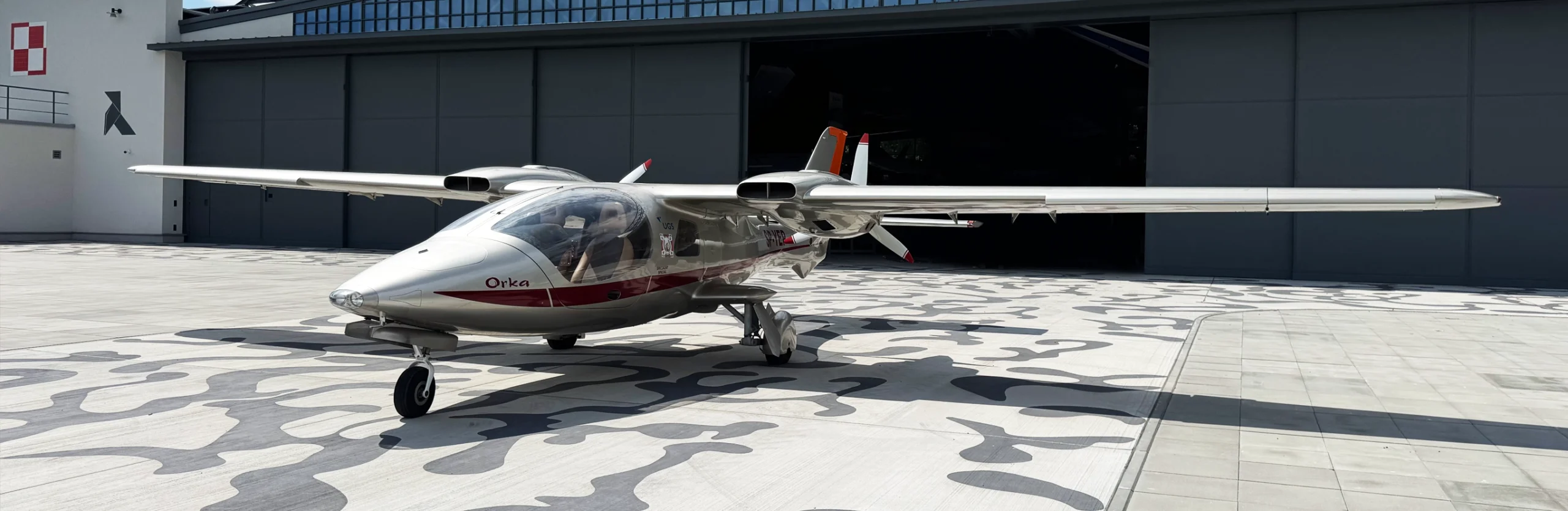
The reconstruction of the propellers for the EM-11 “Orka” aircraft for the Polish Aviation Museum in Kraków is an example of a project where 3D printing is not just a tool – it becomes an extension of the original design concept.
The EM-11 “Orka”, designed by Edward Margański – one of the key figures in light and composite aviation – was an unconventional aircraft for its class. Its twin-engine pusher configuration, slender fuselage, and extensive use of composite materials reflected a modern design philosophy. The “Orka” was intended to be an efficient, lightweight business aircraft, combining performance with operational economy. A critical part of this concept were the propellers – designed specifically for the pusher configuration. Their geometry was far from arbitrary: blade profile, twist, and taper were all carefully defined to ensure optimal load distribution and efficiency at given speeds.
The prototype delivered to the Polish Aviation Museum in Kraków did not include the original propellers, which required these components to be recreated based on available technical materials. This was a demanding task due to the complex blade geometry; however, in this case, additive manufacturing proved to be an effective solution. 3D printing made it possible to accurately reproduce complex surfaces quickly, without simplifying the form to meet the limitations of traditional manufacturing methods.
The project utilized professional 3D printing, including technologies such as MJF, DMLS, and FDM, allowing the process to be tailored to both visual and structural requirements. The reconstructed propellers maintain correct geometry and proportions while meeting exhibition standards. The Orka propellers project clearly illustrates a broader shift. 3D printing services are no longer limited to prototyping – they are becoming a tool for restoring history. In practice, this means breaking traditional barriers in museum work: moving from static displays toward informed reconstruction based on data and technology. In a way, this is a continuation of the same idea – innovation. Where a modern aircraft was once developed, today we use modern tools to complete its story. Fibometry professional 3D printing is not an add-on here – it is an integral part of the narrative about the project, its creator, and the capabilities of contemporary engineering.

At the exhibition “Upwind And Downwind – Civil Aviation” at the Polish Aviation Museum in Kraków, visitors can now see the restored “Orka” aircraft with faithfully recreated propellers produced using 3D printing technology. It is a true honor for us to have contributed to this project and to be part of this unique exhibition.
If you are working on a similar project – whether prototyping, reconstruction, or low-volume production – feel free to contact us via the contact form. We will help you select the right technology and guide you through the entire process, from model to final component.


