

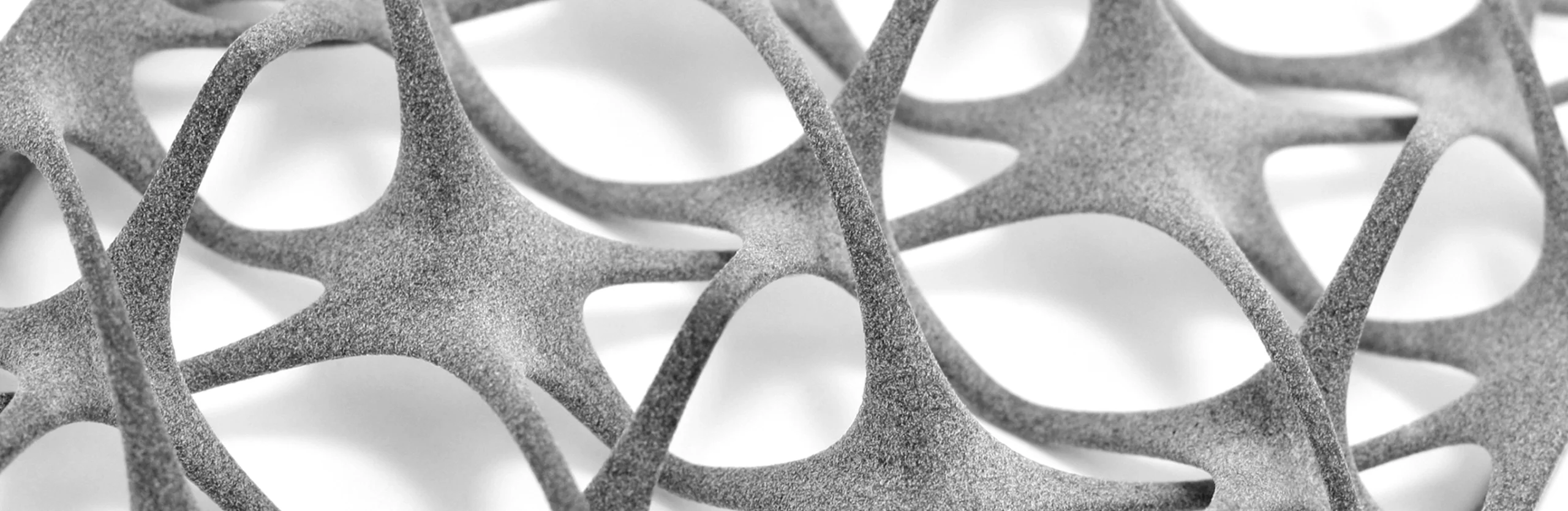
At Fibometry, we offer a full spectrum of 3D printing technologies tailored to the diverse needs of industry, prototyping, and serial production. Each method has its own unique characteristics, enabling projects from early 3D prototypes to ready-to-use functional components. Our goal is not only to deliver high-quality prints, but also to support clients in selecting the best technology and material solution.
Discover our 3D printing technologies and explore dedicated pages where we present their benefits, available materials, and potential applications in detail.
SLS – Selective Laser Sintering
SLS technology enables the production of durable, fully functional parts without the need for support structures. This makes it ideal for complex geometries and larger builds-both at the prototyping stage and in low- and mid-volume production, including end-use parts. We offer materials certified for medical and food-contact applications, as well as optional dyeing and surface smoothing, which improve aesthetics and overall finish quality.
SLS is ideal for 3D prototypes, structural components, housings, flow channels, and technical parts requiring high mechanical strength-also as ready-to-implement end-use components.

MJF – Multi Jet Fusion
MJF stands out for high dimensional accuracy, repeatability, and fast build times. Thinner layers compared to SLS translate into better surface quality and finer detail resolution. This technology is an excellent choice for functional prototypes, short runs, and industrial 3D printing on demand. It’s also worth noting that in low-volume production, MJF can deliver aesthetically pleasing, end-use parts-similarly to SLS, additional smoothing and dyeing are available to enhance appearance and finish quality.
With MJF, repeatable components can be produced quickly using polyamides, flexible TPU materials, or specialized medical-grade materials-while maintaining quality control at every stage of production.

SLA – Stereolithography
SLA delivers the highest surface quality and very fine detail in 3D prototyping. We use a range of resins: standard resins for visual models, engineering resins resistant to impact and temperature, and biocompatible resins for medical and laboratory applications.
Compared to DLP, SLA offers a broader range of specialized materials while maintaining exceptional accuracy. It’s ideal for presentation models, casting patterns, and components that require faithful detail reproduction.

FDM – Fused Deposition Modeling
FDM is a proven 3D printing method, particularly useful for producing large parts and functional components from technical and high-temperature materials. We offer printing with polymers such as PEEK, PEKK, Ultem 1010, and Ultem 9085. This technology enables fast, cost-effective production of 3D prototypes, engineering parts, and manufacturing aids—while maintaining mechanical strength and thermal resistance.
FDM performs especially well in low-volume production, where speed and flexibility in adapting the design to customer requirements matter most.

DMLS – Direct Metal Laser Sintering
DMLS is an advanced metal 3D printing technology that enables complex, fully functional metal parts with high strength and dimensional precision. We print in metals such as stainless steel, aluminum, titanium, and CoCr alloy-supporting components for aerospace, automotive, medical, and energy industries.
DMLS enables rapid production of metal prototypes, structural components, and production tooling while maintaining excellent mechanical properties and material durability. It’s a strong fit for low-volume production, where precision, repeatability, and the ability to manufacture complex geometries not achievable with conventional machining are key.

Why explore our 3D printing technologies?
Choosing the right 3D printing technology is crucial for project quality, functionality, and cost. At Fibometry, we support customers in selecting the best materials and methods. Every project is carefully planned, optimized, and tailored to individual needs-and our support covers the entire cycle: from concept, through prototyping, to on-demand 3D printing and serial production.


