

Advanced Machine Park at Fibometry
Fibometry’s advanced machine park is equipped with reliable Formlabs printers designed for industrial-grade prints using photopolymer resins. Formlabs is a leading manufacturer of professional 3D printers utilizing SLA (Stereolithography) technology, widely adopted by top-tier printing farms around the world – including Fibometry.
What is SLA Printing?
SLA (Stereolithography) 3D printing is a process that uses a precise laser beam to cure liquid photopolymer resins, solidifying them layer by layer to create three-dimensional models. SLA printers work with a broad range of liquid materials that, when properly configured, deliver exceptional mechanical, thermal, and biocompatible properties. The wide spectrum of photopolymers extends the boundaries of 3D printing, enabling the creation of extremely detailed, dimensionally stable prints using certified materials suitable for the medical industry. The medical field, in particular, benefits from SLA technology – it is widely used in dentistry and implantology for manufacturing components requiring high precision and fine detail reproduction.
Formlabs – Precision in Every Detail
The best results in photopolymer resin printing are achieved with the Formlabs Form 3+, which utilizes LFS (Low Force Stereolithography™) technology. LFS ensures unmatched precision and faster print speeds. The laser spot size, reduced to 85 microns, guarantees outstanding detail resolution. Additionally, integrated sensors continuously monitor printer operation and maintain consistent printing conditions, ensuring repeatability and reliability in production.
Do Board Games Use 3D Printing?
The board game industry is a thriving segment of the entertainment market, driven by the popularity of both digital and traditional games. Team games are a great way to spend time with friends or family, as well as a valuable tool for developing collaboration and strategic thinking. While board games are loved by children, their creators – often adults – are responsible for making them visually engaging and detailed. Achieving highly detailed miniature components is crucial in board game design.
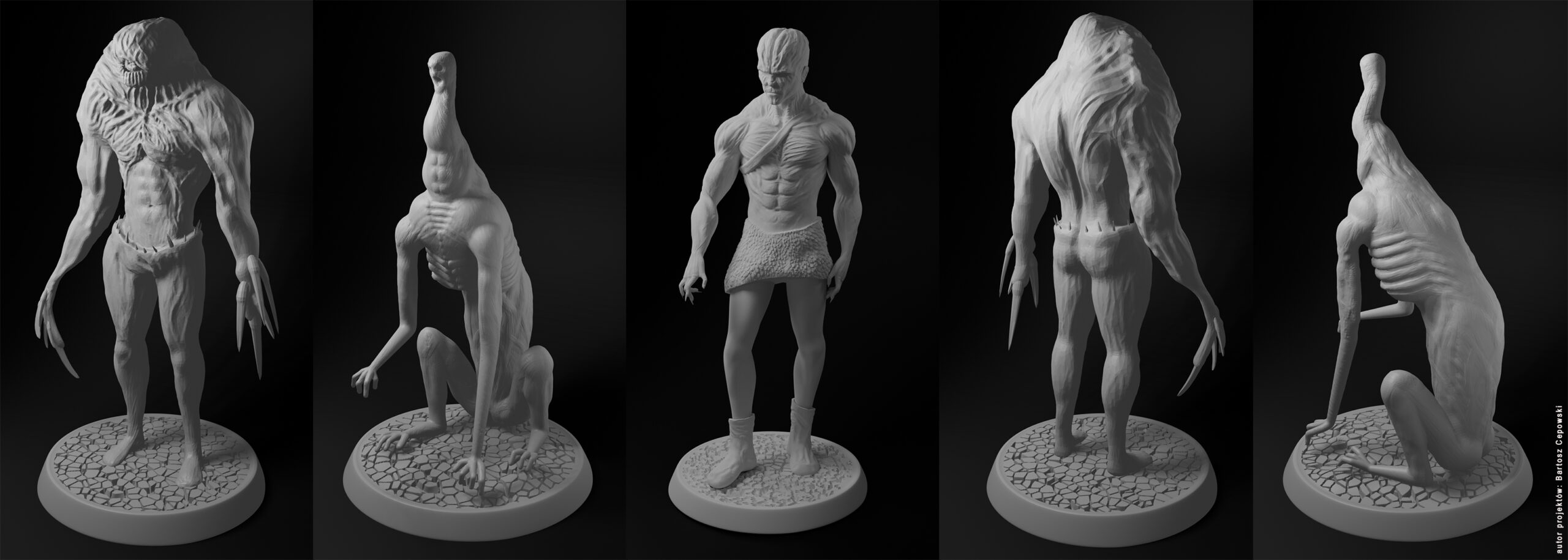
Here, 3D printing plays an invaluable role, enabling designers to produce small, intricate, and complex parts in low production volumes. For printing miniatures, figurines, or detailed game pieces, SLA resin printing is the preferred method. This is one of the most accurate 3D printing technologies, allowing the fabrication of finely sculpted models in limited runs.
The gaming market has become significantly influenced by 3D printing, due to the increasing use of 3D modeling in both board and video game development. This results from the crossover between computer graphics and 3D printing, where digital 3D designs can seamlessly transition from the virtual to the physical world.
3D Printing vs. Injection Molding
3D printing offers major advantages over traditional injection molding, primarily due to its lower production costs for small batches – eliminating the need for expensive molds. Another key benefit is the customization capability: each model can have a unique design without affecting production cost, which depends only on material volume and machine operating time.
Customization and Creativity
Customization is one of the greatest strengths of 3D printing, allowing players to create their own unique figurine designs and build personalized game collections in small series. 3D printing fuels creativity and innovation within the game design community, giving creators the freedom to experiment with advanced technologies and modern materials.
We invite board game designers to collaborate with us – send your model for a free quotation using our contact form.


